Helping crime victims isn’t a “priority” for Cline

Roll Call reports:

Attorney General Pamela Bondi during her Senate confirmation bid pitched herself as a leader with a track record of supporting victims, a history some Republican senators pointed to when backing her nomination.

But after her first months in the role, victim service organizations and their supporters say there’s fear and deep uncertainty about the future of Justice Department funding, something they describe as a mainstay in the nation’s response to helping victims of domestic violence, sexual assault and human trafficking.

The Justice Department wiped from its website a grant opportunity used to assist victims of domestic abuse and sexual assault, only to repost the notice months later. It raised the potential of “consolidating grantmaking work” in certain areas, including the Office on Violence Against Women. And it terminated a swath of grant money directed toward organizations focused on helping crime victims, a decision five groups filed a lawsuit to reverse.

…..

The grant terminations have spurred an uproar from congressional Democrats, while Republicans have largely avoided criticizing the department’s move to terminate the grants.

…..

Rep. Ben Cline, R-Va., who also sits on the subcommittee, said there should be a pullback in government spending.

“We have to prioritize what gets funded and what doesn’t. And at DOJ, law enforcement is our top priority, and Bondi is doing a good job of prioritizing safety and security,” Cline said.

But four years ago Cline posted on Facebook:

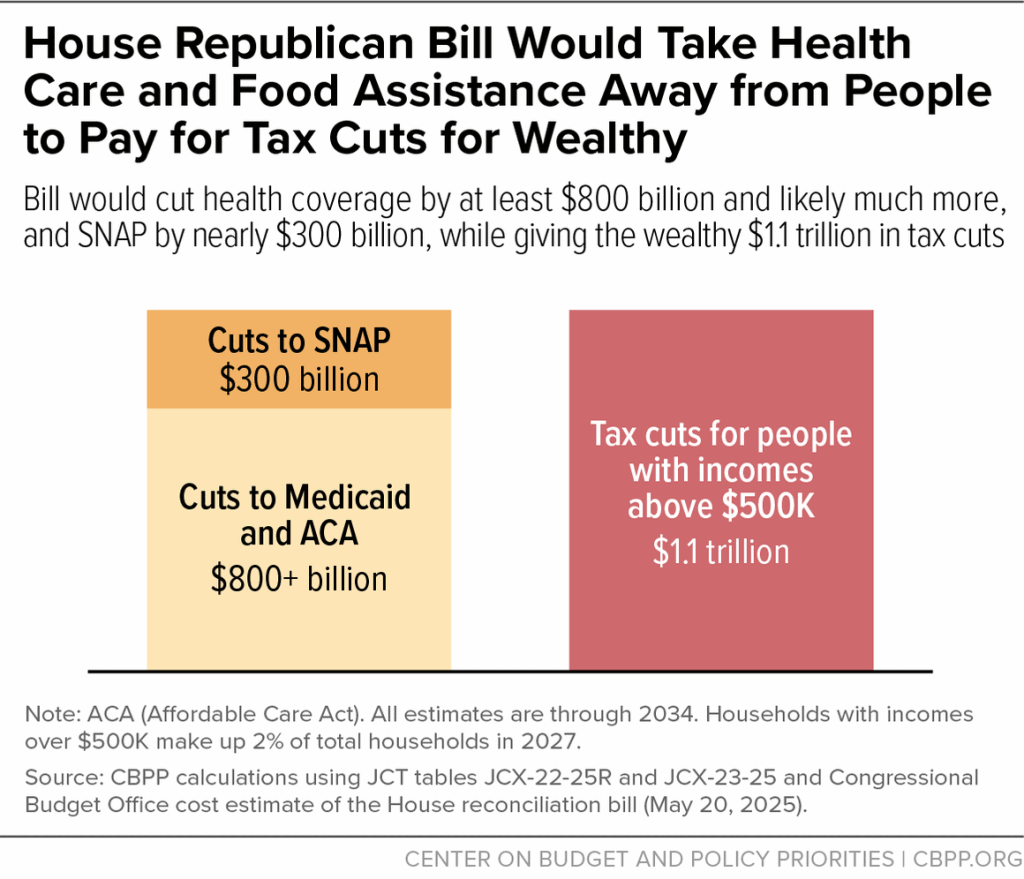
So add assistance to victims of rape and domestic violence to the list of programs that Cline is willing to cut in order to provide people earning more than half-a-million dollars a year with $1.1 trillion in tax cuts.

Cline celebrates passage of big ugly bill

In a Facebook post this morning, Congressman Cline tried to justify his support for Donald Trump’s “One Big Beautiful Bill,” which passed the House of Representatives by one vote, with all Democrats voting NO.

Cline does his best to obfuscate the simple fact that the bill pays for a $1.1 trillion tax cut for the top one percent of earners by cutting Medicaid and the Affordable Care Act by more than $800 billion and SNAP by $300 billion. (Cline’s claim that the bill will “strengthen Medicaid” is a bad joke.)

In other words, the bill would make millions of people sicker and hungrier to help the rich buy more private planes and yachts.

And even with that, the Congressional Budget Office estimates the bill with increase the federal deficit by $3.8 trillion over the next decade.

Cline likes to denounce “deficit loving D.C. Democrats.” What (if anything) will he say now?

USDA cuts off help for local food bank. Does Cline care?

The Washington Post reports:

Virginia’s Blue Ridge Mountains area is largely rural and conservative, with Donald Trump carrying all but two counties that checker the central and western part of the state in the 2024 election.

It is also a place where it has become increasingly difficult for people to find enough to eat.

Every free meal counts there, said Michael McKee, the CEO of Blue Ridge Area Food Bank, which is the main provider of food assistance to 25 counties in the region. But after the U.S. Department of Agriculture paused $500 million in funding for programs related to food in March, Blue Ridge and other food banks have been struggling to meet the growing needs of their communities.

“We’ve never before faced a situation like we are in now, where need is well beyond any disaster or financial crisis that we’ve seen, and the government’s response is to take food away,” McKee said. “This isn’t about ideology. It’s about math.”

…..

McKee said Blue Ridge received no warning from USDA that the food it was expecting was no longer coming. Blue Ridge staff members found out by logging into the government portal and seeing that the 300,000 meals they had ordered had been canceled.

…..

For Blue Ridge, any amount of government assistance to fight hunger is critical as the rural Virginia nonprofit continues to meet a demand that has grown since the start of the coronavirus pandemic. The end of pandemic-era federal assistance, followed by high inflation and low wages, has only made hunger a more pressing reality for more people.

“At the peak of the pandemic in May 2020, we were serving up to 172,000 people each month. We thought it could never get that bad again,” McKee said. “But in the last six months of 2024, we averaged 172,000 people each month.” In March this year, Blue Ridge saw 181,183 visits. In April, the food bank saw 176,844 visits.

The Blue Ridge Area Food Bank serves a large part of Congressman Cline’s Sixth District, including the counties of Augusta, Bath, Clarke, Frederick, Highland, Page, Rockingham, Rockbridge, Shenandoah and Warren, as well as the cities of Buena Vista, Harrisonburg, Lexington, Staunton, Waynesboro and Winchester.

Last month The Augusta Free Press reported:

Not surprisingly, the USDA is not commenting publicly on the cancellation of previously-approved funding through The Emergency Food Assistance Program, which comes on top of the decision handed down from the Trump/Musk DOGE to cancel two Biden-era programs – the Local Foods for Schools Cooperative Agreement Program and the Local Food Purchase Assistance Cooperative Agreement Program – that provided more than $1 billion nationally for schools and food banks to purchase food from local farmers.

Perhaps Congressman Cline can ask his friend Elon about this.

Maybe the congressman can find out why the world’s richest man cut off food to so many of his least wealthy constituents.

But don’t count on it.

In April, both of Virginia’s Democratic senators, all Democratic House members and three out of five Republican House members signed a letter to the Secretary of Agriculture requesting answers about the cutoff and asking if there were alternative plans to provide aid to food banks.

The two non-signers were John McGuire of District Five and (yes) Ben Cline of District Six.

Why is this man smiling?

Congressman Cline posted this on his Facebook page:

Congresswoman Jennifer McClellan, whose 4th District constituents are fortunate to be represented by her, wrote:

As a state senator, I helped lead the effort to expand Medicaid and close that gap in Virginia, and today, more than 605,000 Virginians are covered by that expansion. They can get primary care and live their lives without the fear that an accident or emergency will leave them penniless. [As a member of the House of Delegates, Cline was a leading opponent of Medicaid expansion in Virginia.]

Now that fear and uncertainty has returned for many. Under Republicans’ plan [the One Big Beautiful Bill], Medicaid coverage is on the chopping block along with burdensome red-tape requirements and cost sharing that will make it harder for the Medicaid expansion population to keep their insurance.

In other words, the more than 170,000 of Cline’s constituents who depend on Medicaid (including more than 60,000 covered by the expansion that Cline tried to block) have ample reason to worry about how this bill will affect their ability to receive needed medical care.

Congressman Cline: That’s nothing to smile about.

Another meeting with Ben Cline

Another reminder why Congressman Cline dreads holding in-person town halls open to all his constituents.

An account of a meeting with Cline by Rodney Grandon in The Winchester Star.

My spouse, daughter-in-law, and I recently met with Congressman Ben Cline at his Winchester office. We appreciate the opportunity to share our concerns with Cline, and to hear directly from the congressman.

We were left, however, with the solid impression that as a “conservative in a conservative district” (paraphrasing Cline) he is indifferent to the current chaos unleashed by the Trump administration and to the adverse impact Republican budget plans will have on the 6th Congressional District.

Given limited time with Congressman Cline, we focused on three issues: (1) the adverse impact of Trump’s executive actions and the current defunding plans floated by the White House and Congressional Republicans; (2) the specific impact of Republican spending plans on vulnerable women and children (proposed cuts to Medicaid being among the most hurtful); and (3) Trump’s attack on the Rule of Law.

Among our takeaways: Mr. Cline supports the terror campaign launched by the Trump administration against the federal workforce. He noted that the speed of the cuts was more important than having a merit-based, strategic focus for resizing the federal workforce. While he seemed willing to offer constituent services to those who have lost or may lose their jobs, he is not going to do anything to protect his constituents from Trump’s whims. The question remains whether Cline will step up when the lack of talent crashes the functioning of critical government services.

Cline remains committed to gutting expanded access to health care through Medicaid, a successful initiative under the Affordable Care Act. His position seems particularly callous, noting a recent report from VPM that “one-third of Virginia’s rural hospitals are operating in the red.” That report further explained that these rural hospitals “serve populations that are older, with higher rates of chronic illness and poverty. Many of their patients have a greater reliance on government-funded health insurance programs like Medicaid and Medicare . . . .” Moreover, he seems uninterested in the health care challenges specific to women and children (e.g., access to maternity care and nutrition programs).

Concerning the Rule of Law, Cline trumpets the Trump line: “activist” judges are inappropriately halting Trump’s assaults on our Constitution. Cline ignores the fact that those judges were appointed by, among others, Presidents Reagan, Bush, and Trump himself. The reality is, as many courts have concluded, Trump’s assault on the personal freedoms of our citizens, law firms, universities, federal agencies, federal contractors and grant recipients, and on non-citizens (to name but a few of his targets), are unconstitutional or otherwise unlawful, frequently lacking any factual or legal foundation for the attack. (For example, using the Alien Enemies Act to deport people in the complete absence of any war or falsely claiming “national emergencies.”)

Trump’s goal is to accumulate executive power at the expense of our nation’s people and institutions. No president, whether Republican or Democrat, should have such unfettered power. If Cline really supports the Rule of Law, he needs to turn his sights on the dangerous excesses of the Trump administration.

Cline versus Medicaid

As Republicans in Congress move toward slashing Medicaid, I want to focus on Congressman Cline’s attitude toward the program which provides vital health insurance for more than 170,000 of his Sixth District constituents.

Cline has said that cuts to “traditional Medicaid” are off the table.

On Monday I called Cline’s Washington office and asked the following questions:

• What does he mean when he talks about “traditional Medicaid”?

• Does he mean Medicaid before the expansion that made more people eligible under the Affordable Care Act– which he staunchly opposed as a member of the Virginia House of Delegates?

• Does he want to take away Medicaid from the hundreds of thousands of Virginians who have been able to get health insurance for the first time when Medicaid was expanded– including more than 60,000 of his constituents?

The staffer who answered the phone promised to pass on my questions to the congressman. I await his response.

Cline has also joined the Republican demand for “work requirements” for “able-bodied” adult Medicaid recipients.

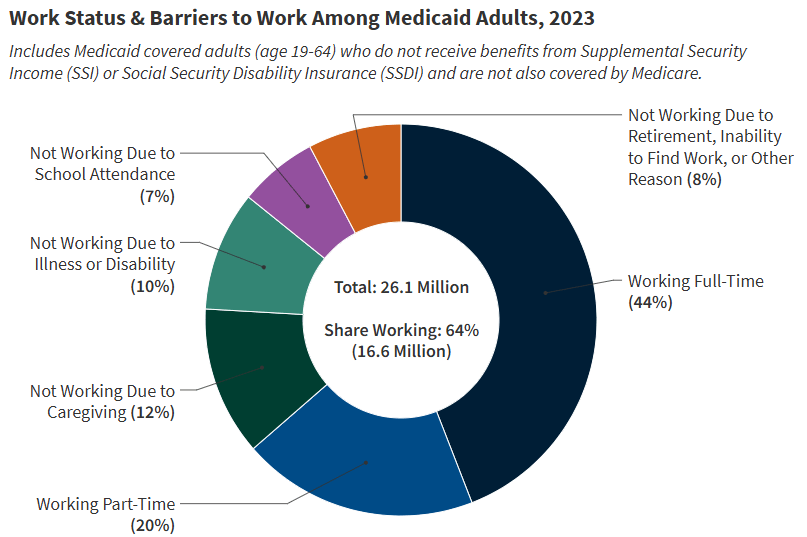
In fact, nearly two-thirds of adult Medicaid recipients are working full- or part-time. Others are not working due to caregiving, illness or disability, school attendance or inability to find work. So while there may be a tiny fraction of recipients who can work but don’t want to, the bureaucratic effort involved in trying to track them down would probably cost more than any savings by removing them from the rolls.

As with school meals, Cline– the self-styled opponent of “burdensome regulations”– is pleased to impose them on low-income people who just might be trying to get away with something.

Cline and the incredible shrinking DOGE savings

Shortly after Trump’s latest election in November, The New Republic reported:

Incoming Department of Government Efficiency head and world’s richest man Elon Musk has proposed cutting $2 trillion in government spending—more than Congress’s entire discretionary budget. But some of Donald Trump’s key allies don’t see anything wrong with that picture.

In an interview with Fox Business on Friday, Virginia Representative Ben Cline claimed that it “absolutely is” possible to slash that much cash from the budget.

“We can do it, and make sure that we focus funding toward the American people and not toward bureaucracy in Washington,” Cline said.

Just a reminder: Congress’s discretionary budget funds practically the entire executive branch, doling out funding for the military, national security, and federal agencies.

Whether Cline believed Musk could accomplish this obviously impossible feat, or if he was just sucking up to Trump and his people as usual, we may never know.

But six months later, we have a clearer idea of the alleged savings that DOGE accomplished.

That is to say, DOGE savings will amount to less than 8 percent of the original $2 trillion target at most— the target that Cline said was “absolutely” possible. Perhaps Cline was overly dazzled by what he considers Musk’s superior brain.

Meanwhile the non-partisan Partnership for Public Service estimates that DOGE’s actions will actually cost taxpayers $135 billion this fiscal year.

PSP’s estimate is based on the $270 billion in annual compensation costs for the federal workforce, calculating the impact of DOGE’s actions, from paid leave to productivity hits. The $135 billion cost to taxpayers doesn’t include the expense of defending multiple lawsuits challenging DOGE’s actions, nor the impact of estimated lost tax collections due to staff cuts at the IRS. 

So it’s entirely possible that DOGE will end up costing us more than it saves— not just in cuts to public services on which millions of Americans depend, but in actual dollars.

And then what will Cline have to say? That is, if we can find him to ask.

A meeting with Ben Cline

Here’s a first-hand account of a recent meeting between Congressman Cline and two of his constituents at his Roanoke office.

It helps explain his dread of holding in-person town hall meetings to which all his constituents are invited.

It was posted on the Facebook page of Dan Smith.

The following description of a meeting with Roanoke Congressman Ben Cline is from longtime advocate Carter Brothers. It tells us, in some detail, what it is like to try to talk to a true-believer who has Trump’s back against the libs. Cline admits to knowing little and says he’ll have to study it, which he does not do. His responses are consistently vague and non-committal, which is not exactly what we expect or want from a representative. Mr. Brothers has done his research carefully and fully. Cline has not and won’t. Cline must be voted out next year.

Herewith Mr. Brothers’ report:

My wife and I recently had a 15 minute meeting with Ben Cline to talk with him about concerns we had raised with his staff. I had most recently met with his staff to ask Ben to support for a new bipartisan bill reasserting Congressional authority over tariffs. Before that meeting with Ben’s staff, I spent more than 5 hours researching the history of tariffs in our country. I found two reports from the Congressional Research Service (the part of the Library of Congress that puts together studies for Congress on important issues) on both the Presidential and Congressional authority over tariffs and on the International Emergency Economic Powers Act (IEEPA), which is the act under which Trump claims his power to impose worldwide tariffs. I presented these reports to his staff along with other research materials and asked if Ben would co-sponsor the House bill to restore Congressional authority over tariffs. I was told by the staff that all materials would be given to Ben to review and they would reply to me with Ben’s response.

We started the meeting by asking Ben if he had ever changed his mind regarding a particular policy after meeting with his constituents in these smaller one-on-one meetings. After reflecting on the question, he said that he probably had but quickly mentioned certain policies that are unlikely to change, and gave as examples his support of “life and the Second Amendment. We did not ask him to clarify what “life” meant.

I asked him if he’d read any of the materials I presented his staff on tariffs and he admitted that he hadn’t, although he said he tries to look at everything constituents give him. It was disappointing to hear he had not prepared for our meeting. When I asked him if he supported Trump’s use of IEEPA to impose tariffs unilaterally without Congressional support, he said he was not up to speed on tariffs as they were not something he had thought about before Trump’s tariff war. He was aware of the recent lawsuits challenging Trump’s authority under IEEPA to impose tariffs and said he would “reserve judgment” while the case played out in the courts. Although he never said this, I assume he meant that he would support whatever result the courts decided, but I should have confirmed that.

We both mentioned that while he was waiting for his answer, the rest of the country would experience not just the anxiety caused by the uncertainty but also the inflationary impacts of Trump’s tariffs. Ben dismissed any concerns over inflation and said he expected all the trade agreements would be worked out by the end of this month (May). He also repeated the argument that Trump has been promised large investments in America, although he acknowledged it might take several years before any new manufacturing plants were up and running. I asked if he would meet next month to follow up on how the trade agreements are going. He said he likely could not meet with me personally, but I could set something up with his staff. He then confirmed what I had already figure out—he would not be co-sponsoring the bipartisan bill in the House to restore Congressional authority over tariffs.

After the tariff discussion, Jen mentioned how several people who know Ben have described him as “a man of deep faith.” We both thought that comment affected him. Jen continued by asking if his faith was leading him to positions that matched Jesus’ commands for us to care for the poor and the least among us since the GOP budget seems to impose drastic cuts to Medicaid programs and other assistance programs like SNAP.

Ben responded by saying “My faith is very important to me, but” and then proceeded to say how he has to represent all 750,000 people in our district–the rich, the poor, those who voted for him, and those who voted against him. I wish I had asked for examples of how he represents us all, but he was still trying to address Jen’s question. He said that traditional Medicaid programs that support the elderly, the disabled, and children would not be affected by the GOP budget, despite the rhetoric coming from the White House to the contrary. He viewed the cuts to Medicaid as changes rather than cuts—changing the work requirements was something he mentioned. Jen pressed him on his commitment to poor and low income people and he promised that Medicaid in its “old” form (his word) would not be affected. I should have said I would reserve judgment as that played out!

By this time, we’d already been interrupted by his staff trying to keep us on track. He was already running late before we got there so he dismissed the staff the first time and said we had a few more minutes.

Knowing we were running out of time, I then asked him about several things Trump has done in addition to the tariffs that look authoritarian and whether they gave him qualms or no qualms. I started with the deportation of people under the Alien Enemies Act and the “mistaken deportation” of Kilmar Garcia. He didn’t like the black and white nature of the question, to which I responded “the only black and white answer is the no qualms answer; if you want to avoid it, then tell me your qualms.” I then mentioned that given the recent federal court striking down Trump’s deportation authority under the Alien Enemies Act and the other federal court giving Mahmoud Khalil a day in court to plead his case, I assumed he’d be reserving judgment until those cases played out. He said he was. Surprised?

When asked if he was aware of the fear running through the immigrant community here in Roanoke and their fear of being deported if they show up for work or for regular Visa appointments, he did say he had heard about that and the impact it was having on local landlords and businesses. When asked if his office would be a resource to help someone who was here legally on a working visa but gets detained at the renewal appointment and threatened with deportation, he said his office would be happy “to look into it if it happens.”

We ended our time with my asking if he had qualms about Trump’s targeting Harvard and Trump’s use of the DOJ to target Chris Krebs. As for Harvard, Ben said Trump was justified if Harvard was not fulfilling its Constitutional duties to protect students from hate speech and discrimination. When asked if protesting Israel’s actions in Gaza was hate speech, Ben conceded such protects were protected speech. I then asked what did he believe Harvard was doing wrong to deserve loss of its tax-exemption. His answer: “I’ll have to look into that and read the report.”

I was more troubled by his response to my question about Chris Krebs. He asked if Chris was the President of Harvard. Wow. Trump signs an executive order directing his Department of Justice to investigate a US Citizen not accused of committing any crime and to go find evidence of criminal activity, and Ben hasn’t heard about this! Although I am sure Ben knows who Chris Krebs is, I explained that Chris was the former US Director of the Cybersecurity and Infrastructure Security Agency who refused to back up Trump’s lie that the 2020 election was stolen (which got him fired, by the way). Trump also revoked his security clearance, causing him to lose his job with a defense contractor, and Trump just revoked his Global Entry membership. Ben said I could give him the details and he’d look into. At this point, I was angry at his lack of engagement with these issues. No, I replied, you are a member of Congress, so how about you look into it since you have greater access to information and then you get back to me. He turned to his staffer in the room and nodded, and then ended our meeting by standing up and heading to the door.

As we were leaving, we gave him a copy of Michael Lewis’ excellent book Who is Government: The Untold Story of Public Service, which, surprise, he said had not read nor heard of. (Side note: the first story is about a Mine Safety and Health Administration worker whose efforts drastically reduced coal miner deaths and injuries from roof collapses, something of significant importance to those of us in southwest Virginia). When the staffer asked if he wanted to take a picture with us, Ben said no. He did post on his Facebook page pictures with the other constituents he met with that day. Sometimes the absence of a picture can also speak a thousand words.

Cline versus the Constitution

Despite Congressman Cline’s professed devotion to the US Constitution (he likes to pull a copy from his pocket at public events), it seems his devotion to Donald Trump is even stronger.

These days Cline appears especially willing to ignore the due process clause of the Fifth Amendment. The clause states plainly that no person shall “be deprived of life, liberty, or property, without due process of law.” (Note: person, not just citizen.)

In his latest weekly newsletter, under the title Standing Up for the Rule of Law, Cline wrote:

Last week, President Trump rightly called out activist judges for blocking efforts to remove dangerous criminals from our communities. Using the Alien Enemies Act of 1798, the administration is prioritizing national security by deporting individuals who entered illegally under the Biden Administration’s failed border policies. I remain committed to upholding the rule of law and the will of the American people. President Trump was elected with a clear mandate to secure our borders and protect our communities, and I stand with him in fulfilling that mission.

One of those dreaded “activist judges” turns out to be a Trump appointee.

A federal judge on Thursday permanently barred the Trump administration from invoking the Alien Enemies Act, an 18th-century wartime law, to deport Venezuelans it has deemed to be criminals from the Southern District of Texas, saying that the White House’s use of the statute was illegal.

The decision by the judge, Fernando Rodriguez Jr., was the most expansive ruling yet by any of the numerous jurists who are currently hearing challenges to the White House’s efforts to employ the powerful but rarely invoked law as part of its wide-ranging deportation plans.

The 36-page ruling by Judge Rodriguez, a President Trump appointee, amounted to a philosophical rejection of the White House’s attempts to transpose the Alien Enemies Act, which was passed in 1798 as the nascent United States was threatened by war with France, into the context of modern-day immigration policy.

The Supreme Court has already said that any Venezuelans the White House wants to expel under Mr. Trump’s proclamation invoking the act must be given a chance to challenge their removal. But Judge Rodriguez’s ruling went further, saying that the White House had improperly stretched the meaning of the law, which is supposed to be used only against members of a hostile foreign nation in times of declared war or during a military invasion.

While Judge Rodriguez’s decision applied only to Venezuelan immigrants in the Southern District of Texas — which includes cities like Houston, Brownsville and Laredo — it could have an effect, if not a binding one, on some of the other cases involving the administration’s use of the Alien Enemies Act.

“The court concludes that as a matter of law, the executive branch cannot rely on the A.E.A., based on the proclamation, to detain the named petitioners and the certified class, or to remove them from the country,” Judge Rodriguez wrote.

He also found that the “plain ordinary meaning” of the act’s language, like “invasion” and “predatory incursion,” referred to an attack by “military forces” and did not line up with Mr. Trump’s claims about the activities of Tren de Aragua, a Venezuelan street gang, in a proclamation invoking the Alien Enemies Act.

But it seems Cline is willing to extend his lax attitude about due process even to American citizens. He joined other Republicans on the House Judiciary Committee to reject an amendment stating that Immigration and Customs Enforcement (ICE) cannot detain or deport US citizens.

If Cline is OK with deporting to Honduras a four-year-old US citizen with Stage 4 cancer who was sent away without medication, he needs to say so. Loud and clear.